What's the Future
  • Home
  • Events
    • Event 1
    • Event 2
    • Interview #1
    • Interview #2
    • Event 3
    • Event 4
  • About us
  • Our Team
  • Articles
    • Medicine >
      • MD/DO
      • Smart Implants: The Future of Medical Devices
      • Artificial Intelligence in Drug Discovery: Accelerating the Search for New Medicines
      • High-Throughput Screening: Finding Needles in Haystacks
      • Liquid Biopsy: A Non-Invasive Way to Detect Cancer
      • Artificial Intelligence in Medical Imaging: Enhancing Diagnosis
      • Robotic Surgery: Precision and Minimally Invasive Procedures
      • Organ-on-a-Chip: Mimicking Human Organs for Drug Testing
      • The Gene-Editing Technology That Could Cure Diseases
      • AI Healthcare: Revolutionizing Diagnosis and Treatment
      • HIV/AIDS Treatment
      • Proton Therapy: A Precise Form of Radiation Therapy
      • Organ Transplantation
      • Harnessing the Immune System to Fight Cancer
      • The Ancient Art of Acupuncture: A Modern Perspective
      • Telemedicine: The Future of Remote Healthcare
      • The Future of Clot-Busting
      • Targeted Therapy: Precision Medicine for Cancer Treatmente
      • Monitoring Health in Real-TimeNew Page
      • Microfluidics in Drug Development: Small-Scale Solutions for Big Problems
      • 3D Printing in Medicine
      • Breast Cancer
      • Nanomedicine
      • COVID-19: The Delta Variant
      • Genetic Engineering
      • Surviving the Next Pandemic
      • Update: Cancer
      • Alternate Personalities
      • Internet Overuse
      • Cloning
      • Covid vaccine
      • Consciousness
      • mask
      • Deja Vu
    • Methodological Innovation in Research >
      • High-Throughput Screening: Accelerating Material Discovery
      • Machine Learning in Materials Science: Accelerating Discovery
      • In Situ Characterization: Real-Time Analysis of Materials
      • Cryo-Electron Microscopy: Visualizing Materials at the Atomic Level
      • Computational Materials Design: Predicting Properties with Simulations
      • Additive Manufacturing: 3D Printing of Advanced Materials
      • Combinatorial Materials Science: High-Speed Material Discovery
      • Nanofabrication: Building Materials at the Nanoscale
      • Self-Assembly: Nature-Inspired Material Design
      • Biomimetic Materials: Learning from Nature
    • New Technologies >
      • Advancements in Renewable Energy Technologies
      • Deep Learning: How AI Learns Like a Human
      • Quantum Computing: The Supercomputer of the Future
      • The Evolution of Wearable Technology
      • The Technology and Challenges of Autonomous Vehicles
      • The New Age of Biotech: CRISPR
      • The Future of Transport
      • Brain-Computer Interfaces (BCIs): Connecting Minds to Machines
      • Augmented Reality (AR): Blending the Digital and Physical Worlds
      • Blockchain and Decentralization: The Future of Trust Online
      • Nanotechnology: The Tiny Science with Big Possibilities
      • Innovations in Human-Machine Interaction
      • War
      • LiDAR
      • 3D printing
      • New energy
      • alphago
      • How Can Virtual Reality Change The World?
      • Metaverse
      • Neuralink
      • Spiral Engine
      • Optimus
    • Future Materials >
      • Aerogels: The Lightest Solids on Earth
      • Metamaterials: Engineering the Impossible
      • Biodegradable Plastics: A Sustainable Future
      • Graphene: The Wonder Material of the 21st Century
      • Carbon Nanotubes: The Building Blocks of Future Technologies
      • Biomaterials: Bridging the Gap Between Biology and Engineering
      • Nanomaterials: The Power of the Very Small
      • Self-Healing Materials: The Future of Durability
      • Shape Memory Alloys: Materials with a Memory
      • Smart Materials: Responding to Their Environment
      • Baking Soda
      • Acids and Bases--Brief
      • Esters and Applications
      • Iodine Clock Reaction
      • Haber Process
      • Elemental Facts
      • Elemental Facts Pt. 2
      • Hall Process
      • Doping
      • Flame Tests
      • Carbon Snake Experiment
      • Chemical Traffic Light
      • Polymers
      • Thermometers
      • Calorimetry
    • The Digital Age >
      • Artificial Intelligence
      • Data Trust
      • Virtual Reality
      • The Popularity of TikTok
      • Blockchain Technology
      • Cloud Computing
      • Edge Computing
      • 5G Technology
      • Quantum Computing
      • Social Media
      • Ecommerce
      • Big data
      • Cybersecurity
    • Climate Change >
      • Airborne CO₂ Capture Technology
      • Global Warming
      • Whale and Dolphin death
    • Jobs >
      • Jobs in coming 10years
      • Telemarketers
      • Bookkeeping clerk
      • Driver
      • benefits manager
      • Receptionist
      • Couriers
      • proofreader
      • Computer support specialist
      • Market research analyst
      • Retail salespeople
      • Advertising Salespeople
      • Human resource manager
      • Writer
      • Sales manager
      • Chief executives
      • Marketing Manager
      • Photographers
      • Esport
    • Space >
      • Mars
    • Sports >
      • Women's Sports
      • Swimming: Tech-Suits
      • NBA: Load Management
  • Contact
  • Home
  • Events
    • Event 1
    • Event 2
    • Interview #1
    • Interview #2
    • Event 3
    • Event 4
  • About us
  • Our Team
  • Articles
    • Medicine >
      • MD/DO
      • Smart Implants: The Future of Medical Devices
      • Artificial Intelligence in Drug Discovery: Accelerating the Search for New Medicines
      • High-Throughput Screening: Finding Needles in Haystacks
      • Liquid Biopsy: A Non-Invasive Way to Detect Cancer
      • Artificial Intelligence in Medical Imaging: Enhancing Diagnosis
      • Robotic Surgery: Precision and Minimally Invasive Procedures
      • Organ-on-a-Chip: Mimicking Human Organs for Drug Testing
      • The Gene-Editing Technology That Could Cure Diseases
      • AI Healthcare: Revolutionizing Diagnosis and Treatment
      • HIV/AIDS Treatment
      • Proton Therapy: A Precise Form of Radiation Therapy
      • Organ Transplantation
      • Harnessing the Immune System to Fight Cancer
      • The Ancient Art of Acupuncture: A Modern Perspective
      • Telemedicine: The Future of Remote Healthcare
      • The Future of Clot-Busting
      • Targeted Therapy: Precision Medicine for Cancer Treatmente
      • Monitoring Health in Real-TimeNew Page
      • Microfluidics in Drug Development: Small-Scale Solutions for Big Problems
      • 3D Printing in Medicine
      • Breast Cancer
      • Nanomedicine
      • COVID-19: The Delta Variant
      • Genetic Engineering
      • Surviving the Next Pandemic
      • Update: Cancer
      • Alternate Personalities
      • Internet Overuse
      • Cloning
      • Covid vaccine
      • Consciousness
      • mask
      • Deja Vu
    • Methodological Innovation in Research >
      • High-Throughput Screening: Accelerating Material Discovery
      • Machine Learning in Materials Science: Accelerating Discovery
      • In Situ Characterization: Real-Time Analysis of Materials
      • Cryo-Electron Microscopy: Visualizing Materials at the Atomic Level
      • Computational Materials Design: Predicting Properties with Simulations
      • Additive Manufacturing: 3D Printing of Advanced Materials
      • Combinatorial Materials Science: High-Speed Material Discovery
      • Nanofabrication: Building Materials at the Nanoscale
      • Self-Assembly: Nature-Inspired Material Design
      • Biomimetic Materials: Learning from Nature
    • New Technologies >
      • Advancements in Renewable Energy Technologies
      • Deep Learning: How AI Learns Like a Human
      • Quantum Computing: The Supercomputer of the Future
      • The Evolution of Wearable Technology
      • The Technology and Challenges of Autonomous Vehicles
      • The New Age of Biotech: CRISPR
      • The Future of Transport
      • Brain-Computer Interfaces (BCIs): Connecting Minds to Machines
      • Augmented Reality (AR): Blending the Digital and Physical Worlds
      • Blockchain and Decentralization: The Future of Trust Online
      • Nanotechnology: The Tiny Science with Big Possibilities
      • Innovations in Human-Machine Interaction
      • War
      • LiDAR
      • 3D printing
      • New energy
      • alphago
      • How Can Virtual Reality Change The World?
      • Metaverse
      • Neuralink
      • Spiral Engine
      • Optimus
    • Future Materials >
      • Aerogels: The Lightest Solids on Earth
      • Metamaterials: Engineering the Impossible
      • Biodegradable Plastics: A Sustainable Future
      • Graphene: The Wonder Material of the 21st Century
      • Carbon Nanotubes: The Building Blocks of Future Technologies
      • Biomaterials: Bridging the Gap Between Biology and Engineering
      • Nanomaterials: The Power of the Very Small
      • Self-Healing Materials: The Future of Durability
      • Shape Memory Alloys: Materials with a Memory
      • Smart Materials: Responding to Their Environment
      • Baking Soda
      • Acids and Bases--Brief
      • Esters and Applications
      • Iodine Clock Reaction
      • Haber Process
      • Elemental Facts
      • Elemental Facts Pt. 2
      • Hall Process
      • Doping
      • Flame Tests
      • Carbon Snake Experiment
      • Chemical Traffic Light
      • Polymers
      • Thermometers
      • Calorimetry
    • The Digital Age >
      • Artificial Intelligence
      • Data Trust
      • Virtual Reality
      • The Popularity of TikTok
      • Blockchain Technology
      • Cloud Computing
      • Edge Computing
      • 5G Technology
      • Quantum Computing
      • Social Media
      • Ecommerce
      • Big data
      • Cybersecurity
    • Climate Change >
      • Airborne CO₂ Capture Technology
      • Global Warming
      • Whale and Dolphin death
    • Jobs >
      • Jobs in coming 10years
      • Telemarketers
      • Bookkeeping clerk
      • Driver
      • benefits manager
      • Receptionist
      • Couriers
      • proofreader
      • Computer support specialist
      • Market research analyst
      • Retail salespeople
      • Advertising Salespeople
      • Human resource manager
      • Writer
      • Sales manager
      • Chief executives
      • Marketing Manager
      • Photographers
      • Esport
    • Space >
      • Mars
    • Sports >
      • Women's Sports
      • Swimming: Tech-Suits
      • NBA: Load Management
  • Contact

Why you Should wear a mask; how wearing a mask can prevent you and your family from contracting COVID-19
​

As the pandemic continues to rage on, with more covid cases on a daily basis due to the new strain of COVID-19; Omicron, many people are at risk of serious illness, particularly those who are elderly, immuno-compromised and unvaccinated. So how can we prevent infection and therefore decrease deaths, one of the simplest and most effective solutions is wearing masks. 


How does Covid Spread?

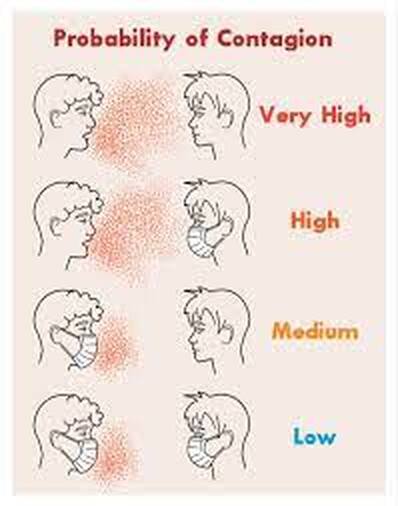
Covid spreads when viral particles from an infected person, (asymptomatic or not) breaths/coughs/sneezes small droplets that contain the virus get into other people's eyes, nose or mouth. In some circumstances covid can spread when a person touches a surface that has COVID-19 on it and then touches their own mouth/eyes/nose, although more often than not COVID is airborne. Ventilation also plays a role in the spread of COVID-19. The CDC recommends that when with others gather outside as much as possible, if not stay in a well ventilated room. The CDC mentions that even a light  breeze can mitigate the concentration of the virus. With less concentration of COVID even if you breathe in some particles, there is a certain amount of viral load required to get you sick. When trying to prevent illness from COVID-19 it is very important to limit viral load as much as possible(Viral load is the amount of viral particles in your body). Wearing a mask will limit the amount of virus an infected person sheds and a healthy person intakes. As seen in the diagram below the lowest possible risk scenario is both the healthy and infected person wearing masks.
Picture

Different types of Masks and their effectiveness at preventing COVID-19

At its most simple form a mask creates a barrier preventing droplets from escaping into the air around you and getting others sick. Certain masks such as N-95s protect you more so than a surgical mask by creating a tight seal around your face to prevent viral particles from getting in as well as getting out. Studies done by the National Institute Of Occupational Safety and Health have proved that N-95 and N-100 masks filter 95 percent and 99.75 percent of particles respectively and surgical masks at 60-80 percent. While an N-95 mask is your safest bet, there is no substantial evidence yet to prove that N-95 respirators protect you more than surgical masks against COVID-19.  If you are wearing either your chances of contracting COVID 19 decrease by at least 80 percent than if you were not wearing a mask. Studies have shown that the most penetrating particle size for  N-95 masks were 30-50 nm while the most penetrating size for surgical masks were 300-500nm. The COVID-19 virus averages from 60-140 NM. This in theory proves that the N-95 is more effective in filtering the COVID-19 virus, but if a N-95 respirator is not available to you a surgical mask is absolutely better than nothing. The most important part about picking and wearing the correct mask is getting a proper seal and fit. If there is leakage out of the sides of the mask the viral particles are not being filtered and the mask will not be nearly as effective. To prevent leakage some precautionary steps can be taken:

  1. Purchase a mask that fits the size and shape of your face
  2. Shave facial hair ( facial hair prevents proper seal against your face and allows for air leakage)
  3. Pinch metal adjustment on the bridge of your nose to proper fit
  4. Check the edges of your mask with your hands as you exhale for leakage, if you feel air escaping attempt to re-adjust your mask until leakage stops, if this is unsuccessful try a new mask.

Conclusion:

In order to end this pandemic it is important that we all wear masks as frequently as possible when with others, especially when indoors. The most effective scenario is when all people wear a mask. As important as it is for a healthy person to wear a mask it is possibly more important for an infected person to wear a mask as well to prevent the spread. Many times COVID-19 is asymptomatic, so although many of us may feel we're healthy and we don't have COVID, this may not be true and we need to wear masks to prevent spreading the virus when we don't even know we have it. Even if you're not at high risk, preventing the spread of COVID-19 by wearing a mask will save the life of a high risk person somewhere down the line. Wearing masks saves lives.

Sources:
SARS-CoV-2 (COVID-19) by the numbers (nih.gov)
How effective is a mask in preventing COVID‐19 infection? (nih.gov)
Microsoft Word - HowBigMicron.docx (yummymath.com)
Ventilation in Buildings | CDC
Proudly powered by Weebly